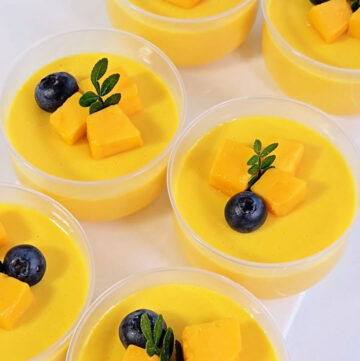
Mango Pudding (Ultra Smooth & Creamy No-Bake Dessert!)
This mango pudding is incredibly smooth, creamy, and melts in your mouth! Made with real mango and simple ingredients, this no-bake dessert is perfect for summer and so easy to make.
Ingredients
Mango Pudding Base
- 400 g mango flesh
- 200 g milk
- 120 g pure milk
- 15 g granulated sugar
- 80 g heavy cream
- 20 g gelatin sheets
Garnish
- Mango cubes
- Blueberries
- Mint leaves
Instructions
- Make the mango milk mixture: Place 400 g mango flesh and 200 g milk into a blender. Blend on high speed until the mixture is completely smooth with no grains or fibrous bits. This mango milkshake mixture should be silky and uniform. Set it aside for now.
- Heat the cream mixture: In a small saucepan, combine 120 g pure milk, 15 g granulated sugar, and 80 g heavy cream. Place the saucepan over low heat and stir continuously with a whisk or spatula. Heat just until the sugar has completely dissolved. Do not let the mixture come to a boil. Once the sugar is dissolved, remove the saucepan from the heat immediately.
- Bloom and melt the gelatin: While the milk mixture is heating, place 20 g gelatin sheets in a bowl of cold water. Let them soak for 5–10 minutes until they are fully softened. Once the milk mixture is off the heat and still warm, remove the gelatin sheets from the water, squeeze firmly to remove any excess moisture, and add them to the warm milk mixture. Stir until the gelatin is completely dissolved and no visible pieces remain.
- Combine and strain: Pour the mango milk mixture from step 1 into the gelatin-milk mixture. Stir thoroughly to combine. Now, for the silkiest possible texture, strain the entire mixture through a fine-mesh sieve twice. This step removes any remaining pulp, foam, or undissolved particles, ensuring a flawlessly smooth, grain-free pudding.
- Chill to set: Carefully pour the smooth mango pudding mixture into individual pudding cups, ramekins, or small bowls. Gently tap each cup on the counter to release any trapped air bubbles. Place the cups in the refrigerator and chill for at least 4 hours, or until completely firm and set.
- Garnish and serve: Once the puddings are fully set, remove them from the refrigerator. Garnish the top of each pudding with fresh mango cubes, a few blueberries, and a small sprig of mint leaves for a vibrant, fresh finish. Serve chilled and enjoy.
Made this recipe? I’d love to see it!Tag @cookingwithchun and share it with #cookingwithchun on Instagram.